Beyond Zero Trust: Why Application Isolation Is Becoming the Next Evolution of Cybersecurity
I've been in IT long enough to remember when Zero Trust felt radical. The idea that you shouldn't automatically trust anything inside your own network was, at the time, genuinely controversial. Now it's table stakes. But here's what I've noticed over the past couple of years: organisations are implementing Zero Trust and still getting caught out. Not because the framework is wrong, but because it was designed for a world where most of your critical applications are modern, cloud-aware, and built with security in mind. Unfortunately, a significant proportion of enterprise applications were never built with those capabilities in mind.
So let me explain why I think application-level isolation is fast becoming the most practical next step for organisations that have done the Zero Trust groundwork but still have uncomfortable gaps.
The part Zero Trust doesn't fully solve
Zero Trust is fundamentally a network and identity model. Verify the user. Verify the device. Grant the minimum access needed. That logic works well when your applications can participate in modern authentication flows — OAuth, SAML, MFA, certificate-based access. But what about the applications that can't?
In almost every organisation I've worked with, there are applications sitting outside that model. ERP systems from the early 2000s. SCADA platforms that haven't been patched since a vendor went under. Bespoke line-of-business tools written by someone who left the company a decade ago. These systems can't be enrolled in your identity provider. They can't participate in conditional access policies. They often run on accounts with local admin rights because that's the only way they function.
Zero Trust, however well-implemented, largely has to work around these applications rather than through them. That's not a criticism — it's just an architectural reality.
Real-world example:
A food manufacturing business running production scheduling software last updated in 2009. The software controls line speeds and batch records. It won't install on anything newer than Windows 7. The vendor is gone. Zero Trust can protect the perimeter around it — but the application itself sits in a kind of security no-man's land.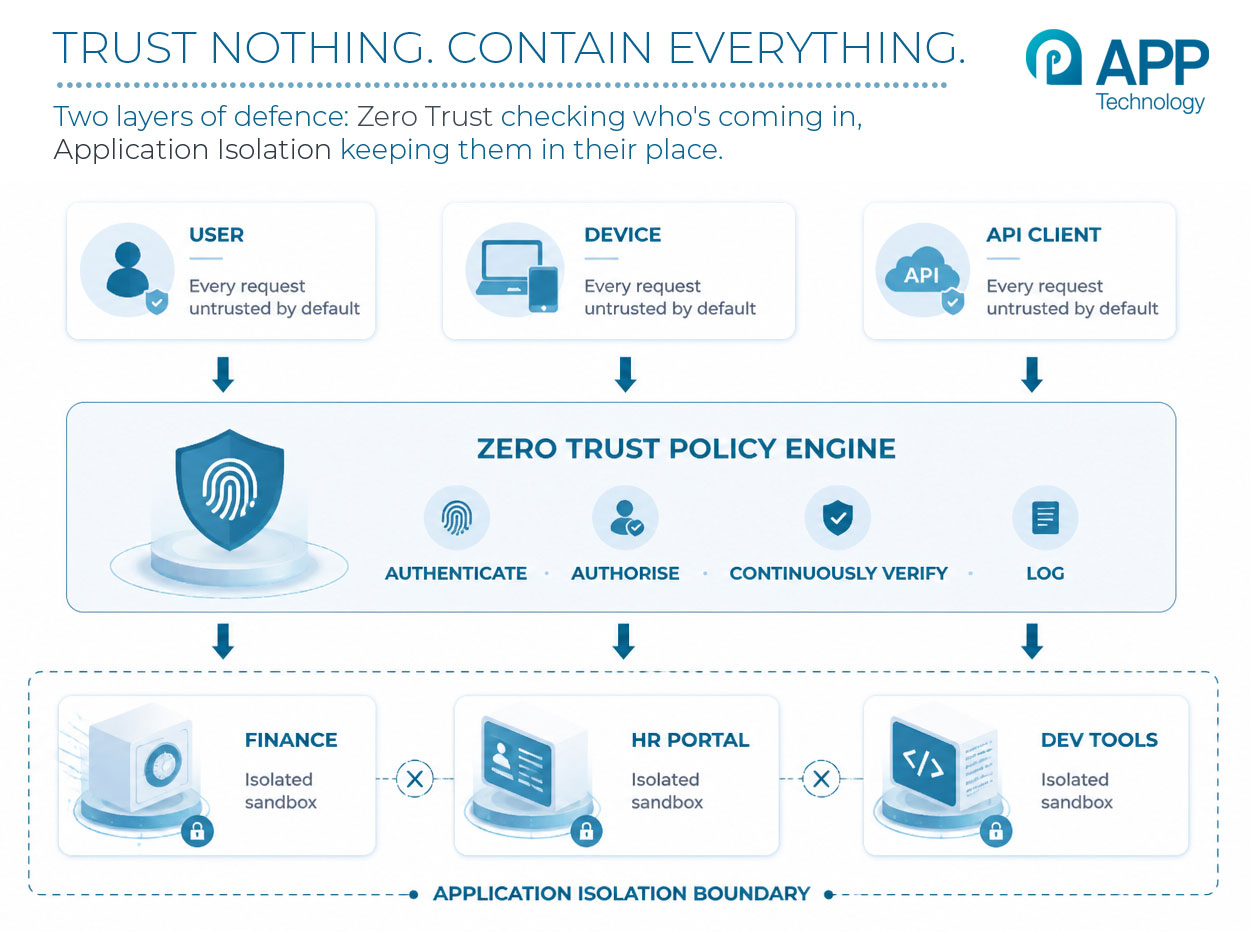
What application isolation actually means in practice
The core idea is straightforward: instead of trying to secure the network path to an application, you secure the application's execution environment directly. The application runs inside a container that is isolated from the host operating system and the network. By default, nothing can communicate with it that isn't explicitly permitted. The application can't reach out; external systems can't reach in.
The practical effects of this are significant. If the application has unpatched vulnerabilities — and many do — those vulnerabilities can't be exploited remotely because there's no route in. If someone compromises a user's device, they can't pivot through the application into the broader network because the application has no network access beyond what's been whitelisted.
This is lateral movement prevention done at the application layer rather than the network layer, and for legacy systems it's often far more achievable.
Real-world example:
A county council running a housing management system on Windows Server 2012 R2. Server 2012 R2 is end-of-life. The application vendor has told them a replacement is two years away. Containerised isolation keeps the application running on modern infrastructure while the council waits — without leaving an unpatched server exposed on the network.The operational technology problem
OT environments are where I see the most anxiety right now, and with good reason. Industrial control systems, building management platforms, utilities infrastructure — these were designed for longevity, not security. Refresh cycles are measured in decades, not years. And the consequences of getting it wrong aren't a data breach; they're a production line stopping, or worse.
Traditional security frameworks struggle here because the systems simply don't support the mechanisms those frameworks rely on. You can't deploy an endpoint agent on a PLC. You can't enrol a DCS in your identity provider. The architecture wasn't built for it.
Application isolation sidesteps this problem by creating a protective layer around the application that doesn't require any changes to the application itself. The system carries on doing what it does; the isolation layer handles the security.
Real-world example:
A water utility running SCADA software to monitor treatment plant operations. The software vendor requires that no security agents be installed on the host machine — any modification voids support. Containerised delivery lets the utility run the SCADA platform in a secure, isolated environment without touching the application or triggering support issues.Cross-platform and compliance benefits
Two secondary benefits that often don't get enough attention.
First, cross-platform. Most application isolation approaches work across Windows, macOS, Linux, and ChromeOS. For organisations with mixed estates — and that's most organisations now — this means a single delivery mechanism for legacy applications regardless of what device the user is on. That simplifies management considerably.
Second, compliance. NIS2, Cyber Essentials Plus, ISO 27001 — all of these require demonstrable controls around access, patching, configuration, and audit. Legacy applications that sit outside your normal management tooling create audit headaches. When those applications run inside managed, isolated containers, you get logging, access controls, and configuration management essentially for free. The auditor sees a controlled environment; you see less paperwork.
My take
I'm not suggesting application isolation replaces Zero Trust — it doesn't. What it does is address the category of systems that Zero Trust was never really designed for. Used together, they give you a more complete picture: modern systems secured through identity and access controls; legacy and OT systems secured through isolation and containment.
If you have systems in your estate that you know are a problem but feel too entrenched to touch, it's worth exploring whether containerised isolation might be the practical path you've been looking for.
Talk to an Expert
Contact us today to discuss how APPtechnology's application isolation technologies could help fill the gaps that your organisation's Zero Trust policy leaves open.